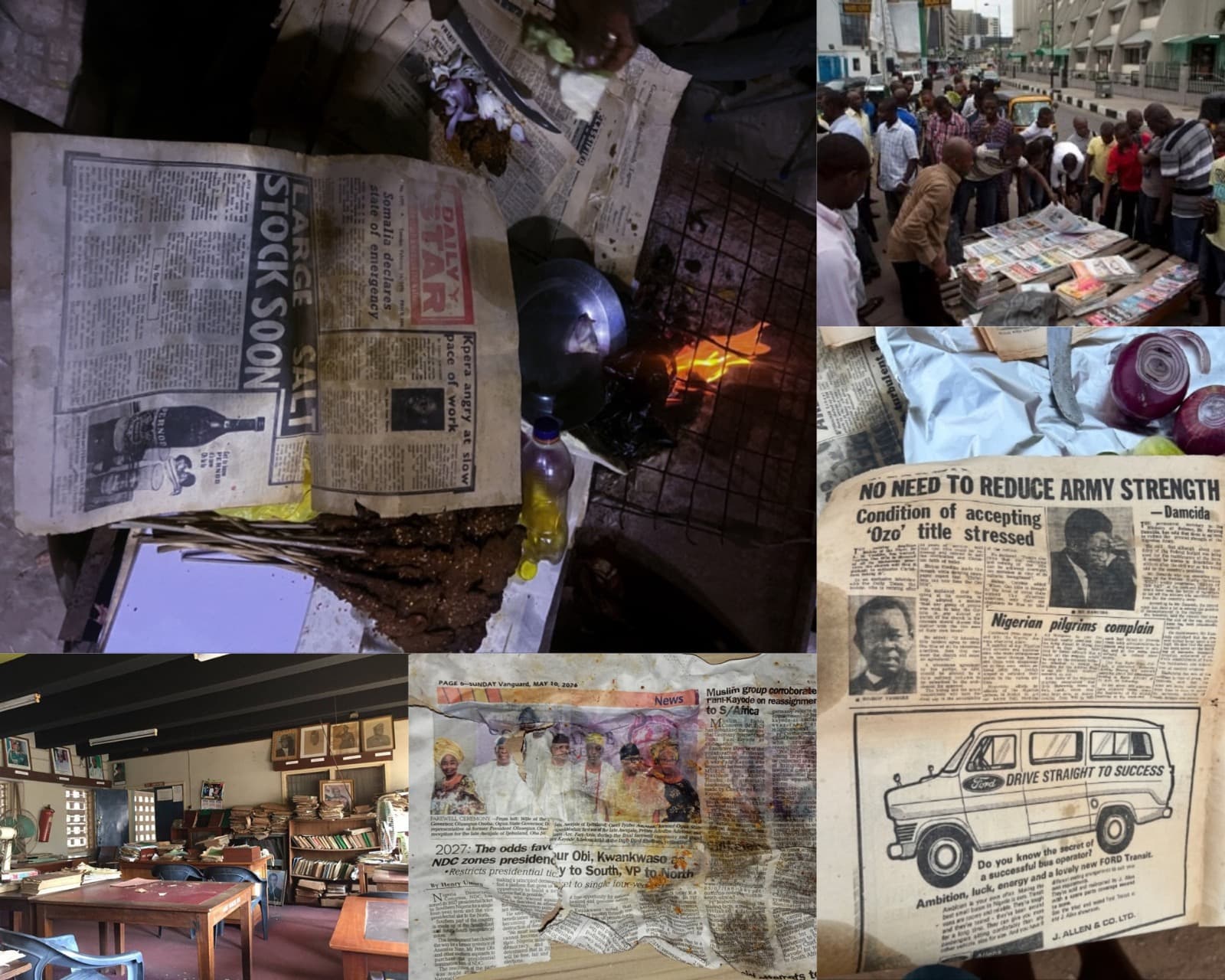
In Arochukwu, as in many towns in the East, the Christmas season brings about a buzz of liveliness that never quite dies down, regardless of the time of day. The morning and afternoon hours see the narrow roads choked with pedestrians and vehicles as the competing calls of sporting activities, age-grade meetings, launchings, and other social gatherings pull people into motion. By evening time, after the dust has settled from the ekpo masquerade performances, the suya vendors, the final actors of the night, man their stations along the long stretch of windy road that runs through the villages of Obinkita, Ibom, and Amannagwu—the heart of the town.
For my cousins, siblings, and me, it had become tradition for us to make a stop at our favorite suya guy on most evenings. We found Abdul* (a pseudonym) at his usual spot. Through the hot smoke wafting from the grill, you could see him wearing his usual jolly mood, earbuds slung casually over his ears, as he tended to the sizzling meat on the grill with great care. We bumped fists and exchanged greetings in Hausa and Igbo and while Abdul went to work prepping our order, my eyes fell to the table on which he worked, lazily scanning for something to cling onto and fill the time.
It occurred to me then that I had actually never bothered to take in the contents of any of the newspapers our orders were usually served in.
“Abokina, I fit see this paper?” I asked, pointing at the heap of pre-stacked newspapers on Abdul’s workbench. Looking up from his onion-chopping for a brief moment, Abdul nodded and flashed a toothy, white smile, handing me one from the stack. I unfurled the newspaper and glanced at the headline. What I proceeded to read left me stunned.
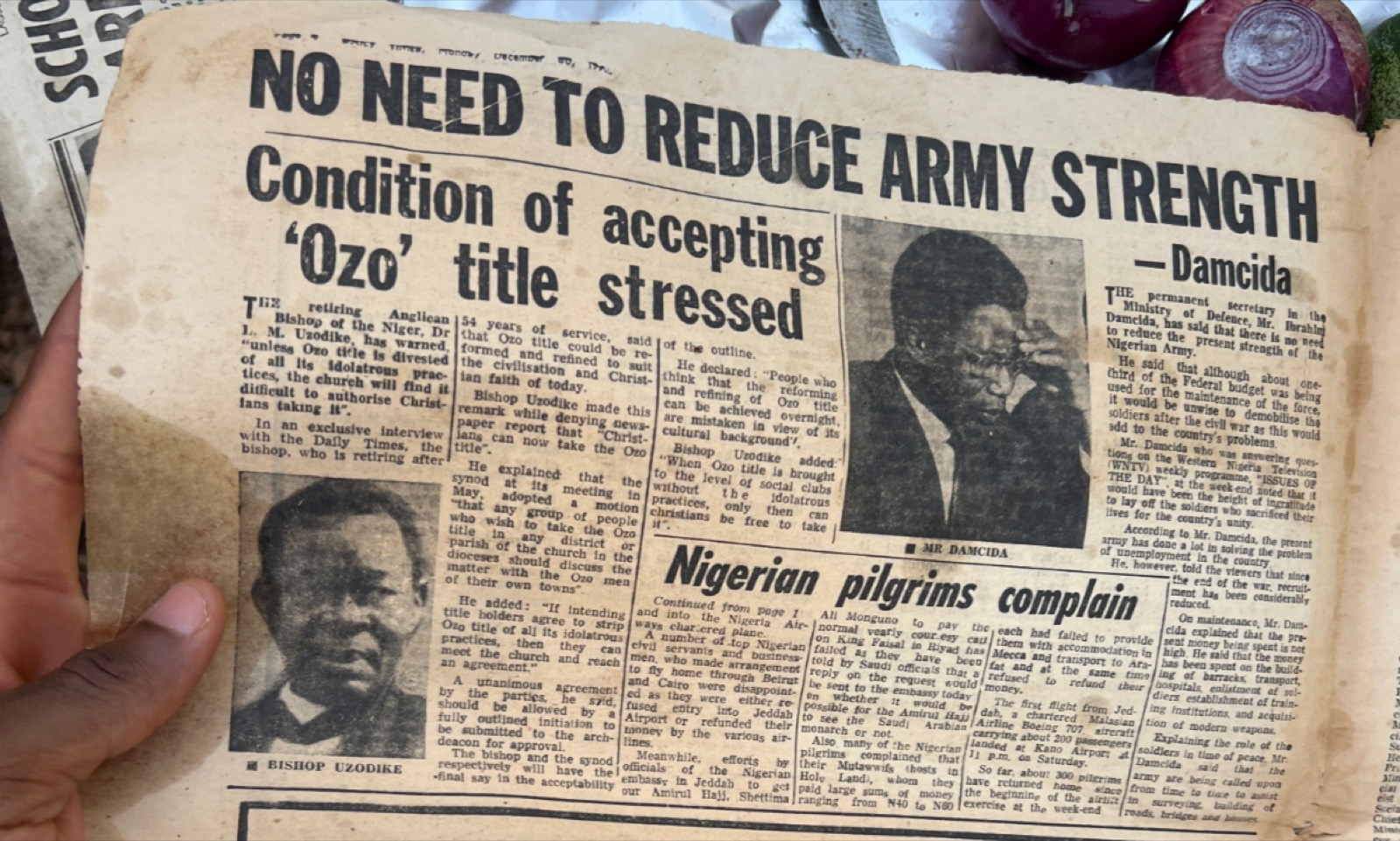 Daily Times, 30 December 1974
DAILY TIMES
“NO NEED TO REDUCE ARMY STRENGTH” – Damcida
“Condition of accepting ‘Ozo’ title stressed”
Monday, December 30, 1974.
These two headlines point to important events in Nigerian history. Following the Nigerian-Biafran War, the Nigerian Army had grown from a small force of less than ten thousand professional soldiers to a behemoth of several hundred thousand personnel who desperately needed to be kept busy and productive. In peacetime, such a large standing army was an undue strain on the country’s resources and administrative capacity—estimates were that about one-third of the Federal budget was being used for the maintenance of the force—and by the early 1970s the country was engaged in deep discussion on what to do with its army.
Ibrahim Damcida was a civilian administrator and permanent secretary to the Ministry of Defence who argued that the expense was justified since army recruitment was solving the larger issue of unemployment. Furthermore, he argued that the funds deployed went into the building of hospitals, barracks, roads, and other key infrastructure in addition to acquiring modern weapons for the force. Interestingly, for Nigerians today, the echoes of Damcida’s argument can still be heard in familiar campaign promises that aim to recruit 50 million unemployed youth into the Nigerian Army and feed them with home-grown corn.
The second headline points to a heated debate within the Anglican Church of Nigeria regarding whether or not its members could take the Ozo title. In much of northern Igboland (what is today Anambra, parts of Imo, and Enugu), the Ozo society functions as a traditional institution of noblemen of distinguished character who influence the politics and religious practices of their community. In many of these communities, the Ozo title, which enables membership in the Ozo society, was and still is considered the highest traditional distinction and honor one could achieve. The debate on whether the rituals and functions inherent in one’s identity as an Ozo man could be reconciled with Christian doctrine was one that rocked the Anglican Church and left much at stake for many Igbo Anglicans who felt they were being forced to choose between their faith and culture.
In 1974, the Anglican Bishop of the Niger, Dr I. M. Uzosike, warned that “unless Ozo title is divested of all its idolatrous practices, the church will find it difficult to authorize Christians taking it.” To many Anglican Nigerians and Christians around the country, such a stance defined a rigid moral metric by which they could navigate the reality of their seemingly conflicting identities as tradition-rich Africans and Christians. Little did they know that fifty years later, the world would revisit this same conversation following Vatican Cardinal Pietro Parolin kissing and crowning the 1,700-year-old skull of Saint Agatha during a Catholic veneration ritual ceremony.
What was at first a quick stop for street food had left me with many questions that I now had to find answers to. How were these newspapers sourced? Were old newspapers being reprinted and distributed for this very purpose? And, more fundamentally, how do newspapers, holders of the nation’s history, become the choice material for wrapping meat?
The newspaper in my hand was more than an old piece of paper. It was one fragment of how a society records and remembers itself. But the newspaper was not where this story of memory began. Long before the archive, the library, or the newspaper existed, people had other ways of keeping the past alive.
Every society develops systems and frameworks for remembering. For the Igbo people of Eastern Nigeria, memory was preserved in living, breathing elements of tradition—in art, performance, titles, names, proverbs, and in stories that systematically survived from one generation to another because the young always sat by the elderly to listen. Because for the Igbo people, to engage history was to pursue education, to seek entertainment, to perform age-long rituals.
This memory infrastructure experienced massive disruptions with Westernization, including the looting of African art during the colonial era, the introduction of western education with its curriculum, and the adoption of English as the country’s official and educational language. With the shift away from oral traditional literature, the libraries and archives inherited the responsibility to carry the full weight of this modern nation’s remembrance.
Today, in 2026, we must reassess and ask the question: have they fulfilled this responsibility?
As the more cultural systems of communication phased out, we turned to radio, newspapers, and later TV to report the present and disseminate information. We recognize this today as the era of traditional media. Newspaper stands became town halls where people gathered in the morning to get news highlights, digest stories, and trade commentary. Almost every home had either a radio, a TV, or both. This served, for the most part, the crucial function of media and information propagation. However, more than just news, they were creating a draft of the nation’s memory, and it was equally as important for these to be preserved. And this, perhaps, is where we fell short. Newspapers occupy a curious place in this sector—distributed in the morning and considered outdated by the next day. Yet decades later, they become some of the most valuable records of everyday life.
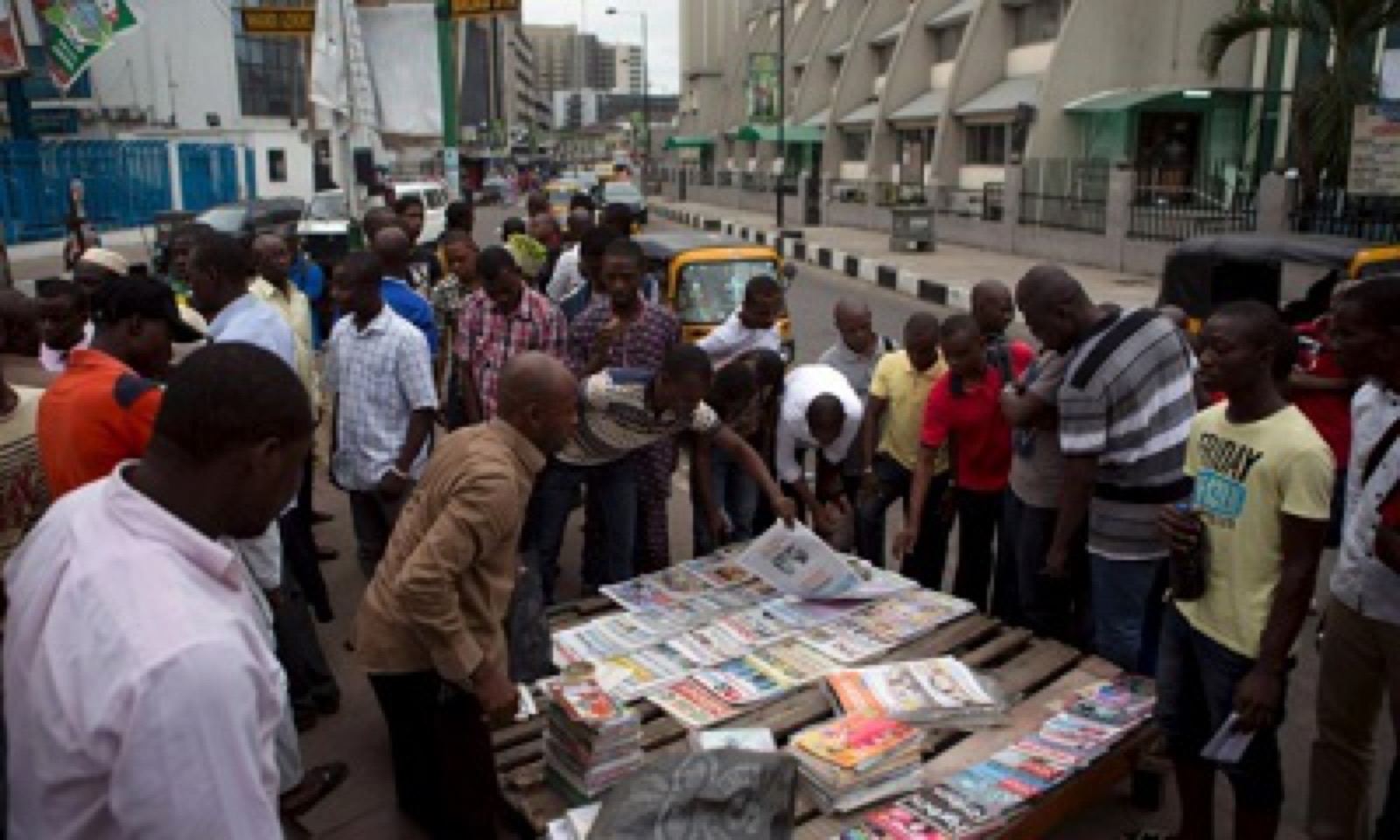 Newspaper stand. Photo: The Guardian
Abdul, the suya vendor in Arochukwu, had mentioned to Kennedy that the papers came from Umuahia. When I connected with him later to try to find the source, he explained that his batch had come from a colleague. He did not know if they were reprinted or if there was a distributor in the market. I had him check with his colleagues and contacts; perhaps there was a way to get to this supplier, perhaps there were more old newspapers to be found. Sadly, when he called back, it was to say that the papers had been used up. Neither he nor his colleagues had a link to this source in Umuahia, or knew how to get a hold of more vintage newspapers. He had chanced upon this one, and had done with it the only thing he knew to do.
But how widespread was this practice? Was what Kennedy stumbled upon in Arochukwu an isolated occurrence, or were old newspapers finding the same fate in other parts of the country? If these papers were indeed circulating through informal markets, how far did that network extend, and were vendors sourcing them from the same kinds of places?
This prompted us to investigate the suya market in the Enugu metropolis, to see if there was a pattern. In Abakpa Junction today, whichever side of the ever-breathing, ever-stirring road you ended up on, you would find that steaming meat still greases the face of newspapers every evening. The same goes for the park in Artisan. I found, from interacting with some of the vendors, that in these parts, the newspapers are generally two weeks to a month old. And after customers had picked off the meat, what remained were newspapers stained, torn, and nearly unsalvageable.
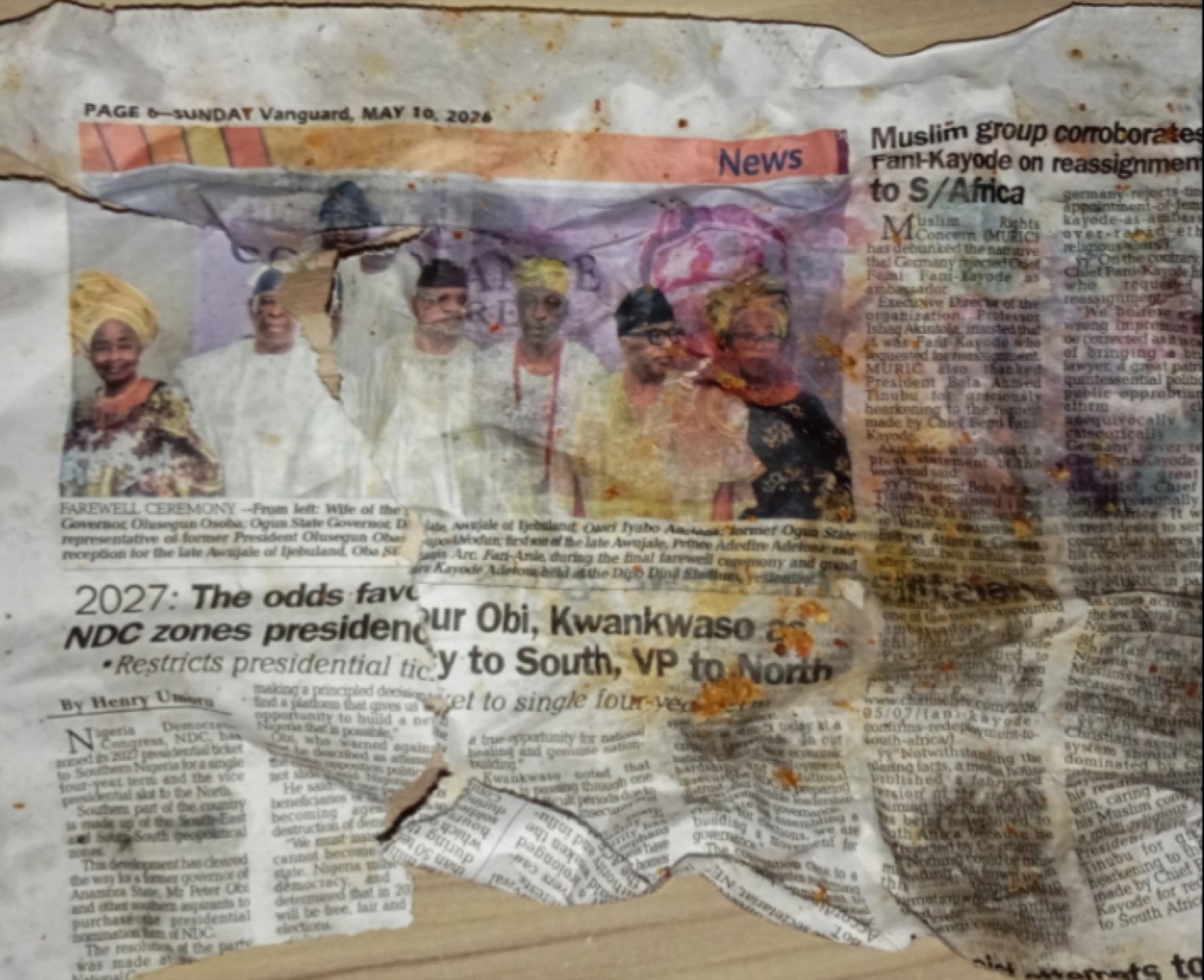 Vanguard, 10 May 2026
VANGUARD
“The odds favour Obi, Kwankwaso as NDC zones presidency to South, VP to North”
Sunday, May 10, 2026.
A few of them bought theirs directly from newspaper stand operators who were trying to offload old newspapers they could not sell, while the majority referred me to wholesalers in a market in Artisan.
“Why e come be say na newspapers una de use wrap suya?” I asked one of the vendors. “How the thing take start?”
“Na so people de do am, even before me. And many customers no de like any other thing wey no be newspaper.”
The rest of them would echo the same thing: We met it this way and merely continued the practice. We don't mind switching to other wrappings but the customers seem to want their suya in newspaper.
The wing of Artisan market where the wholesalers operated dealt in meat of all kinds, from live goats to chicken, beef, and all the things that went alongside meat. It made sense that they would be the ones to sell old newspapers, because, as I would learn shortly from my conversation with them, the only people who came looking for these outdated papers were suya vendors. The bulk of their inventory was the same month-old papers that circulated these parts. When I insisted on older ones, one of them reached deep into his cupboard to retrieve a long-abandoned issue from 2006. They did not know of any major distributors of old papers in Enugu. He had gotten this issue years ago in Kano, while in transit, and they had stayed with him for this long because they were too old and no one wanted to buy them. I dusted the front page to reveal the headlines.
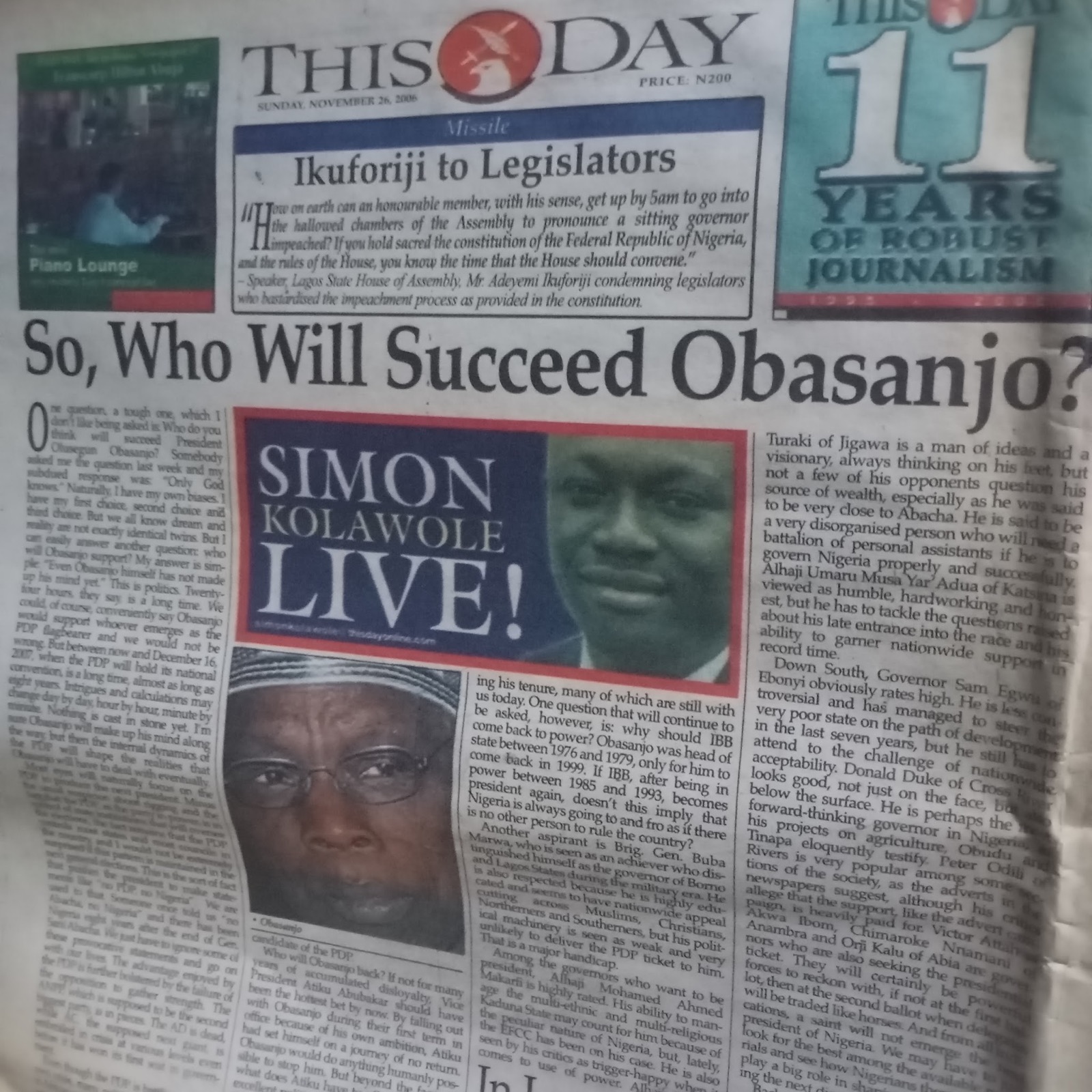 ThisDay, 26 November 2006
THISDAY
“So, who will succeed Obasanjo?” –Simon Kolawole Live.
“Atiku: I'll Strengthen Anti-graft Agencies”
Sunday, November 26, 2006.
At this time, the Olusegun Obasanjo administration was nearing its end, and Vice President Atiku Abubakar had his sights set on the presidency. This ambition persists nearly twenty years later, as he currently campaigns as the ADC presidential candidate for the 2027 general elections.
To me, these headlines and the newspapers themselves were a reminder that as Nigerians, we have a memory problem. While the country’s museums, archives, and cultural institutions visibly shrivel from lack of funding and proper care, the deeper extent of Nigeria’s cultural apathy is revealed discreetly and unceremoniously every evening on the oily grill of local suya vendors. Vintage newspapers, dated as far back as the ’60s and ’70s, all the way to the 2000s—bearing records of events, court decisions, occasions, individuals, conflicts, aspirations, and fears that define our collective story—are somehow the ritual objects of our evening suya runs. Our history is being used to wrap meat and there seems to be no explanation for this.
Beyond serving as suya wrappers, outdated newspapers have found application in the unlikeliest of places. As schoolchildren in the early 2000s, we wrapped them, as well as old calendars, around our exercise books to protect the books from wear. In some rural areas, over the years, homes have used them as alternatives to toilet paper. With millions of pages of these newspapers printed every day and the papers perceived to lose relevance once they are out of date, there is a need to find other uses for them. And without intentional documentation, the risk is that certain issues may be lost, and with them a part of our history disappears.
This problem extends beyond newspapers. Documentary filmmaker, Ayo Shonaiya, mentions on the Afrobeats Podcast how he learned that the Nigerian Television Authority (NTA), the country’s first TV station, had recorded over its old tapes. According to his source, their practice involved recording new programs over old tapes once the programs had been aired, with no plan for preservation or documentation.
If newspapers disappear into roadside stalls and television recordings are taped over, is it safe to say that we are diagnosed with systemic amnesia? Where does one go to find this country's memory?
I visited The National Archives of Nigeria Enugu in search of old documents. First known as The Public Record Office, the National Archives was established in 1954 to preserve the country’s documentary heritage— government records, historical documents, newspapers, manuscripts, maps, photographs, books, and countless fragments of Nigerian history from the precolonial era.
I signed in and settled into the search room, the air light with the smell of brown, brittle paper. I looked through volumes of simple lists of records in their possession, mostly relevant to the Eastern region. When I asked for the oldest Nigerian newspapers they had, the archivist disappeared into the records room and emerged with issues of The Eastern Nigeria Guardian from 1940 and The Nigerian Standard from 1950, stacked within a thick folder to protect it, yet fragile and tender. Details of court judgments, major shifts and events that shaped the country we have today, sitting quietly in a folder. The same newspapers carelessly ripped apart and wrapped around meat at the bus stop ten minutes away—an interesting contrast.
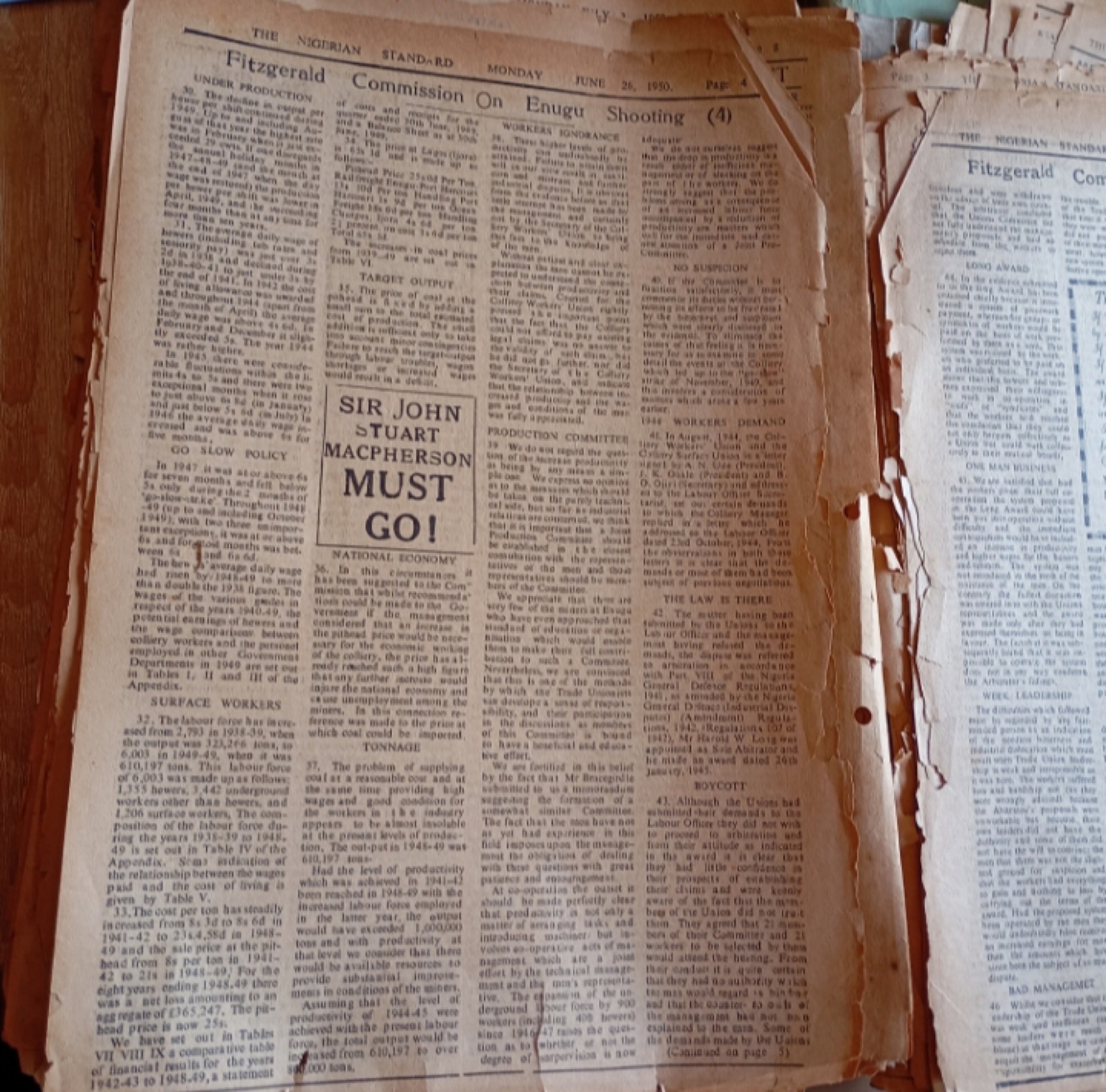 The Nigerian Standard, 26 June 1950. Photo: National Archives Enugu
It is important to note that, though the first recorded publications were regional, the history of newspapers in Nigeria goes back to 1859. How much of these have we lost and how much have we kept? The state of the documents sitting in the archives also raises certain concerns. How confident are we that they would survive the next 50 years? And if these copies disappear, where else do they exist?
History often seeks to interact with the present, to remind us that nothing happens in isolation. Vintage and recently outdated newspapers find their way back into circulation, even when there's no conscious effort to reproduce or distribute them. Even when they're marked for destruction. It's a reminder that the present will become the history of the future, and that what we live through today therefore needs to be preserved and remembered.
Across the country, a growing number of individuals and organizations are rethinking how Nigeria remembers. Preservation is only half the work. History and memory must also be accessible. A newspaper sitting on a shelf survives but it cannot easily influence public memory. When these documents are digitized, they become searchable, shareable, reproducible, and capable of reaching audiences far beyond the walls of an archive’s search room.
One of the most ambitious efforts in this direction is Archivi.ng, a repository on a mission to digitize 2 million pages of newspapers and magazines, and 10,000 hours of oral history by 2027, with over 200,000 pages across 40+ publications currently archived. They also facilitate programs to connect the past to the present and derive meaningful insights from preserved history.
If newspapers preserve the events, photographs preserve the faces of the people involved, the landscapes, clothing, architecture, and everyday lives. The National Museum Lagos boasts a digital archive featuring unpublished manuscripts, maps, government reports, pictures of heritage museum objects and artefacts. A step further than just housing these materials, they put together educational programs for children and for researchers, guided tours, digital exhibitions, and public events, all geared towards bringing the museum's offerings to the public.
Ukpuru, a digital archive of pre-colonial and early 20th-century history houses photographs of the Igbo people and neighboring parts of Eastern Nigeria. Other notable institutions in this category include the National Repository of Nigeria, as well as the National Archives of Nigeria, which has a digital collection called The National Archives Ibadan Library Section, containing a thousand records of documents and publications relevant to Western Nigeria—one would love to see sections for Southern, Eastern and Northern Nigeria as well. These institutions leverage social media to reach millions of Nigerians and inspire them to engage with our history, thereby helping shape public memory.
It is important to note, in this endeavour, that we must not approach digitization of documents, photographs, and oral history with tunnel vision. Servers fail. Formats become obsolete. Websites disappear. Digital media also requires preservation.
Are we now able to answer the question: How does Nigeria remember?
Countries don’t remember on their own. No single institution can hold the entire nation’s memory. Therefore, remembering becomes everyone’s responsibility. People build institutions, archives, museums, and digital repositories that remember and make these stories accessible. People support these institutions. The question this essay really asks is whether Nigeria has been a good steward of its own past. Oral stories survived for centuries because people deliberately retold them.
Our collective story lives in each one of us, on our streets, in boxes in our country homes. Tomorrow, another newspaper will wrap yet another parcel of suya somewhere in Nigeria. Someone will squeeze it up and wipe the oil off their hands before tossing it in the bin without reading it. Someone else may pause, unfold it, and discover a forgotten headline. They may take pictures of these pages and share them with the next person, or with their communities.